Explore the 3I ATLAS latest news and find out what this interstellar comet means for Earth and science.
Imagine a messenger from a distant star system drifting into our solar neighbourhood – quietly, at first, almost unnoticed – before turning heads across the scientific world. That’s exactly what the interstellar object known as 3I/ATLAS is doing. As the exact match for the suggestion keyword, let’s call it 3i/atlas, and follow its tale: what it is, why it matters, and what we should know today.
When you gaze up at the night sky, most of what you see is part of our own solar system – planets, moons, asteroids, comets that were born here. But every now and then something different drifts in: a cosmic wanderer from another star system. That’s 3i/atlas, a visitor that prompts one simple emotional reaction: awe. Because it’s rare, mysterious, and for a moment, it connects us to the vastness of space beyond. It’s not threatening—but it is deeply fascinating.
What was the 3I ATLAS Latest News ?
The object called 3i atlas (sometimes rendered as 3 I/ATLAS) was first discovered by the survey system Asteroid Terrestrial‑impact Last Alert System (ATLAS) in July 2025. The “3I” designation stands for “third interstellar” — meaning it’s the third confirmed object to come from outside our solar system (after 2I/Borisov and 1I/‘Oumuamua).
It is classified as a comet-like body rather than an asteroid. Its orbit is strongly hyperbolic: that is, it is not bound to the Sun’s gravity in a normal elliptical orbit, but is simply passing through.
The object appears to have a nucleus (solid core) of uncertain size; estimates suggest it could be between roughly 0.3 km and up to 5.6 km in diameter.
Why does this matter? Because this means we have a physical piece of another star system in our sights – giving scientists a chance to examine material that formed elsewhere, under different conditions.
Will the 3I ATLAS hit Earth?
Short answer: No. The orbit of 3i atlas has been carefully tracked, and while it is passing through our solar system, it does not pose a threat to Earth. It will not collide with our planet.
In fact, from observations its closest approach to Earth is about 1.8 astronomical units (AU) — roughly twice the distance from Earth to the Sun — according to some sources.
Therefore, while the idea of a giant comet from another star might sound scary, there is no reason for alarm. Instead, it’s a moment to observe and learn.
What does NASA say about the 3I ATLAS?
NASA and other space agencies have been closely monitoring 3i/atlas. According to NASA:
- The hyperbolic orbit confirms it came from outside our solar system.
- It is classified as an interstellar comet – meaning it likely formed around another star, traveled through space for a very long time, and now is passing through our solar neighbourhood.
- Observations via telescopes such as the Hubble Space Telescope and others are helping scientists refine its size, chemistry and behaviour.
NASA emphasises that even though it’s moving fast and behaves somewhat unusually, the evidence strongly indicates 3i/atlas is a natural body – not an alien spacecraft or engineered object.
Can I see the 3I ATLAS?
For the general stargazer: probably not with the naked eye or simple binoculars; this object is faint and far. According to data, it will not get bright enough to easily see without a decent-sized telescope.
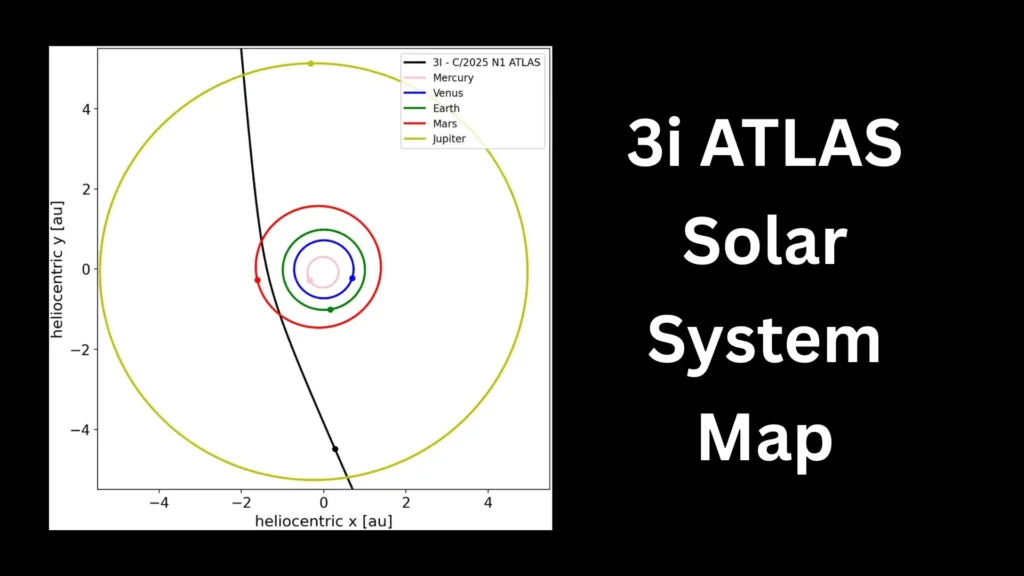
Because of its trajectory and the fact that it passes behind the Sun from Earth’s vantage point at times, viewing it is complex. Some advanced observatories are capturing images.
If you are an amateur astronomer with proper equipment and good skies, you could follow updates from agencies and observatories about the viewing window; for most people the key here is fascination rather than a visible spectacle.
What’s special about the 3I ATLAS (the “acid test” for interstellar visitors)?
Here are some of the standout features that make 3i/atlas particularly interesting:
- Very high speed and hyperbolic path: Because it isn’t bound by the Sun’s gravity in a usual way, its incoming and outgoing trajectory suggest a visitor from another system.
- Unusual chemical composition: Studies show it may have a high ratio of carbon dioxide ice compared to water ice — far higher than typical solar-system comets.
- Tail behaviour and jets: It’s been observed developing a tail and even a jet of material pointed toward the Sun in a somewhat odd orientation.
- Older than our solar system? Some estimates suggest it could be billions of years older than our 4.6 billion-year-old solar system.
Together, these are the “acid test” features: do interstellar visitors behave like familiar comets, or do they surprise us? 3I/ATLAS is leaning toward “surprise”.
Where is 3i/atlas now and when will it be closest to Earth?
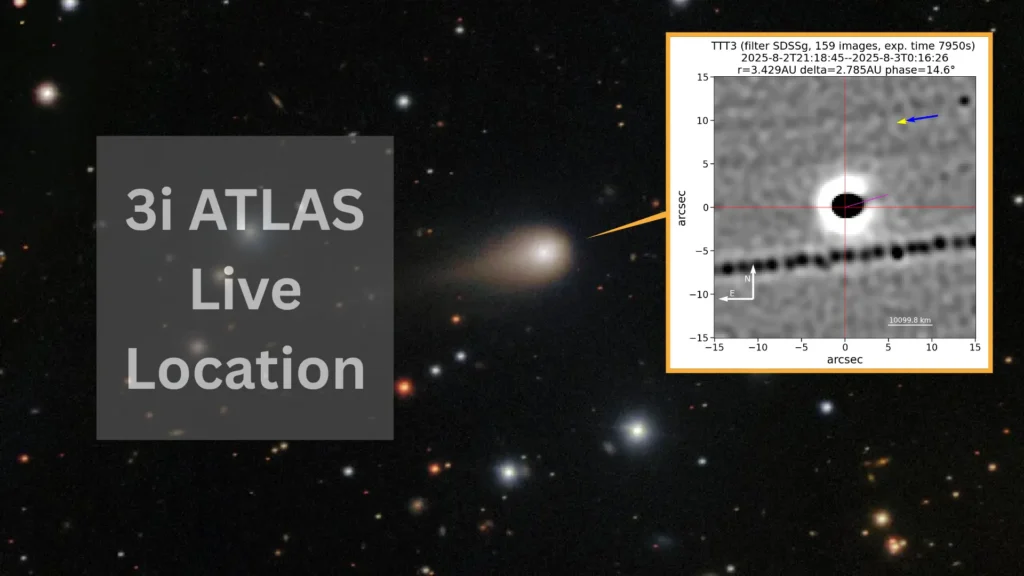
Tracking this visitor:
- Its perihelion (closest approach to the Sun) is expected around late October 2025.
- The object is moving through the inner solar system and will then depart outward again—on its way out of our solar neighbourhood, never to return.
- Its closest distance to Earth is not extremely near; on the order of tens to hundreds of millions of miles, so while interesting scientifically, it’s not a close pass in human terms.
For readers in India (and elsewhere), this means: You can keep an eye on announcements and images, but don’t expect a dramatic naked-eye show.
Should I be worried about the 3I ATLAS?
No – there’s no cause for fear. All the credible data indicate 3i/atlas poses no risk to Earth. Its orbit, distance at closest approach, speed and predicted path all show it will pass by safely.
Rather than worry, this is an opportunity. A rare chance to observe material from beyond our solar system and learn more about our place in the galaxy.
Why this matters (and why you might care)
- A window into other star systems: Most of what we study comes from our own solar system – asteroids, comets, planets born from the same disc. But 3i/atlas brings us material formed elsewhere.
- Testing our theories: The oddities in its chemistry and behaviour challenge standard models of comet formation and evolution.
- Public fascination: Rare cosmic events like this capture our imagination and remind us of the grand scale of the universe.
- Future science: With more powerful telescopes coming online (such as the James Webb Space Telescope) we may discover many more interstellar objects; 3i/atlas is a precursor of what might become routine.
Concluding Thoughts
Here’s what we can say: The visitor 3i/atlas is not a threat – it is a treasure. A treasure of knowledge, of cosmic perspective, of wonder. It reminds us that our Sun and planets are not the whole story; they are part of a vast sea of stars, solar systems, and wanderers drifting between them. In observing this object, we observe a piece of the galaxy’s broader story.
Whether you’re a casual stargazer, an educator (like yourself, Vinesh), or simply someone who loves to step back and marvel at the universe – 3i/atlas is something to follow. It connects the everyday world with the extraordinary.
Also Check: Top AI Headlines Today: Exclusive Global Updates & News
Frequently Asked Questions (FAQ)
Q1. What is 3i atlas?
A. 3I/ATLAS is an interstellar object discovered by the ATLAS survey. It’s believed to have originated outside our solar system.
Q2. Why is it called “3I”?
A. The “3I” stands for the third interstellar object ever detected, following ‘Oumuamua (1I) and Borisov (2I)’.
Q3. When was 3i atlas discovered?
A. It was first detected in 2024 by the Asteroid Terrestrial-impact Last Alert System (ATLAS) in Hawaii.
Q4. How fast is 3I/ATLAS moving?
A. 3I/ATLAS travels at a hyperbolic speed, meaning it’s moving too fast to be captured by the Sun’s gravity and will eventually leave our solar system.
Q5. Will 3I/ATLAS come close to Earth?
A. No, current calculations show it will pass at a safe distance and poses no threat to Earth.
Q6. What makes 3I/ATLAS different from regular comets?
A. Unlike most comets formed within our solar system, 3i atlas has an unusual orbit and composition, suggesting it came from another star system.
Q7. Is there any evidence that 3i atlas is artificial?
A. No. While some theories compare it to ‘Oumuamua, there’s no scientific proof that 3i atlas is anything other than a natural interstellar object.